Tuesday, 23 June 2009

How to protect your child's skin from the sun


The major exposure age level of the skin to the sun takes place before the 20 years of age. Protecting the vulnerable skin of children helps to reduce the future risk of skin cancer.

Although children of white parents are more susceptible and have more probabilities of getting sunburnt, but nevertheless dark skinned children are not free from the risks. Most parents are not aware that sun burns in early childhood are one of the causes of skin cancers (malignant melanoma, carcinoma of basal cells, carcinoma of flaky cells.et Ce tra) and early signs of aging in adult age.

In general, it is advisable, to keep children, away from exposure to sun in the hours of greater intensity (between 11a.m and 4p.m on sunny days), when the sun’s intensity is at its highest, that is when 70% of the ultraviolet radiation take place.

Sun protecting Cream

- make sure kids are protected with a sunscreen or sun block, and one with a solar protection factor of at least 15(SPF 15). This means that the time for a sun burn to occur is reduced at least 15 times than when the child wasn’t wearing a sun protecting cream.

- It must be a cream with protection of ample phantom, which means blocks UVA rays as well as UVB rays. The lotions that blocks the more dangerous UVA rays with titanium dioxide leaves a white layer on the skin, but this does not bother the children. It’s advisable to avoid the lotions that contain PABA (p-amino benzoic acid). PABA produces frequent allergies, and stains the clothes in an indelible form.

- remember that you must apply the cream or lotion 30 minutes before exposure to the sun and, then, every two hours and after each bath (except if the product’s prospectus or guide says that it is water resistant).

T-shirt and hat

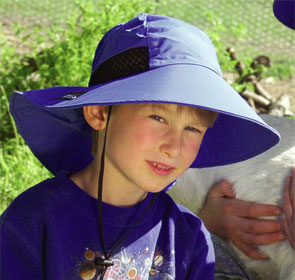
• Always cover to babies and younger children with a clothing e.g. t-shirts (made of cotton) and hats.

• encourage the kids to bathe with their t-shirts on: this also helps to reduce the sun’s penetration. The sport stores sell whole body bathing suits that also offer major protection.

-make sure the kids are dressed in cotton clothes, with bright colors ,because bright colors reflects the sun rays and help the child remain in the right temperature.

Parasol

-do not forget that the skins of new borns are extremely sensible. Until recently, the pediatricians recommended avoiding solar creams until the baby turned six months. Now, several studies have discarded injurious effects on babies, but it should only be used with care, that is, in small quantity. Even with them, the babies must always be protected from the sun.

• Always cover baby’s car with a parasol or make sure his/her hat is always on.

If, in spite of everything, the child get sun burnt:

• Apply a humid cloth in the burned area.

• If the child is above five years, apply congealed vegetable packages (always wrapped in a cloth, never apply directly) on the reddened zone.

• bicarbonate of soda diluted in water or aloe Vera cream helps refresh the skin and calms the burns.

• The creams with a small percentage of hydrocortisone (from 0.5% to 1%) reduce the pain and contribute to the healing process.

• If the child has about 10% of the body sun burnt, and has signs of dehydration (dry skin and lips, confusion, lethargy…), has blisters, fever or complains of pain, you have to call the doctor.


Reblog this post [with Zemanta]

Friday, 29 May 2009

How to prevent accidents in the home

When they begin to crawl or to take their first steps, the house becomes a fascinating world that the children need to explore. Everything draws their attention: from the switch of the television and the controls of the washing machine to the handles of the drawers and the toilet seats. Discovering their surroundings is a prerogative for children; but these surely depend on a series of absolutely essential measures, since the home is the place where the majority of the infantile accidents occur.

Basic norms

- The plugs with earthen wares are safe-- In any case, it is necessary to cover them with plastic protectors. In the market there are models that make it difficult for children to unplug with ease.

- To eliminate the access to windows-- never put chairs or furniture too close to the window panes, because kids might climb on them and fall out of the windows. Better still, if it is possible, you can block their opening.

- In the balconies, the railings must be high and the distance between the bars very short.

- keep away the sewing and tool boxes out of children’s reach.

- protect the corners of the furniture especially and those of the crystal tables with quilted protectors

- Place nonskid underneath the carpets

- make sure that the toys are adapted for the age of the child and do not contain small pieces which they can swallow and choke on.

- To avoid that the children stick and injure their fingers with the doors, exist in the market, door protectors that prevents the door from closing completely.

- don’t leave small batteries, burners or matches in eyeshot of the children, or either small objects like coins or buttons which can be taken to the mouth.

- With plastic bags also it is necessary to take precautions. The small children can asphyxiate themselves if they put their head in them. Please keep away from their sight

- Dangerous products such as, medicines of all kinds, must be outside their reach, in closets, under lock and key.

- To try not to take medicines in front of children (they have the tendency to imitate adults) and in no occasion should you tell them it is sweets or candy, (for example, even when you want to convince them to take it when they are ill).

In the kitchen

- Never leave children alone in the kitchen when cooking or when the oven is ignited.

- The oven is better in a high place, if it is not then, it is necessary to avoid children coming close to it.

- why frying ,make sure that the handles of frying pans and casseroles always are facing inwards, so that they do not extend outwards ,that kids might pull at them and get burnt . In the market they exist in addition protective for kitchen fires.

- Sharp Knives, scissors and other utensils must be outside the reach of children

- The cleaning products (detergents, bleaches, chemicals and soaps) should be kept in a high closet instead of underneath the sink.

- In the market there are also protectors for refrigerators, to avoid easy opening by the children

- The door of the washing machine must always be closed when not in operation.

- The pressing iron, even when not connected, must always be outside the reach of the children

In the bath

- The falls or injuries here can be serious due to the hardness of the toilets and the ground. In order to avoid this, it is necessary to make sure that the ground is always dry.

- At the head of the bathtub it is necessary to always place a nonskid carpet

- make sure that the temperature of the bath water is always suitable

- Never leave children alone in the bath: it is possible for a child to get drowned in little water too. For greater security a special chair for bathtubs can be used in the tubs.

- Never leave hanging around the basins, razor blades, shaving sticks, cosmetics, scissors, etc

- The small electro domestics (hair dryer, hair,) should never be left connected after use and not even kept near the bathtub or the washbasin

- The toilet is another pole of attraction for the children, but also it can be a center of infections. In order to avoid them opening it you can install a simple safety clip which you can get in specialized stores.

- When the toilet is cleaned, it is necessary to avoid kids coming close to it. The cleaning products give off toxic steam, for that reason when finalizing it is necessary to flush again to clarify well.

- The bath is not the best place for the medicine kit due to the humidity, but if it is placed there, it must be inaccessible to kids and must be under lock.

In the garden

- If there is a swimming pool, never leave the children without monitoring them. In order to avoid accidents a security fence can be installed. It is necessary to be especially aware of the risks that involved in the water purifier, the filters and the falls near the curb

- The cork sleeves or bubbles are safer than the floaters for the children who do not know how to swim. With the floaters the child might turn face down and be submerged under water.

- Whenever the gardening tools are used, it is necessary to make sure you return them to a place that must be inaccessible to the children

- The insecticides; fertilizers, installments and the chlorine for the swimming pool must be stored in a safe place.

- It is necessary to consider that some plants are toxic and their fruits, mostly those with red colors, might be very poisonous.


Reblog this post [with Zemanta]

5 reasons babies cry

Crying...Image by joelwillis via Flickr

Have you ever wondered why your little bundle of joy can't stop crying no matter how hard you try to console her.......I guess like I did before I found out this tips too.........you also tried singing to her and doing all that you used to hear on the TV and books you've read.
Sure ,crying is a baby's only way of communication-----but that doesn't mean you'll always know exactly what he or she is trying to say.,
Well ,not to worry ,I've got good news for you ,the reasons for those wails, whimpers and shrieks aren't farfetched.

• reason 1.......I'm hungry
This kind of cry is a short low-pitched cry that rises and falls rhythmically and has a pleading quality to it........and usually associated with lip smacking, finger sucking, and pity-eyes gaze at you, and if you are nursing, baby makes little grabs at your blouse.

• reason 2........I'm bored
This cry starts out as coos ,then turns into fussing.......when he or she isn’t getting the attention expected, then builds to burst of indignant crying, alternating with wimpers.This crying can only stop when the baby is picked up or given the desired attention.

• reason 3..........I'm uncomfortable or Exhausted
A whiny, nasal, continous cry that builds in intensity is usually baby's signal that he or she feels cold or hot, needs a diaper change, fresh clothes, or simply overtired.

reason 4...........I'm in pain
This cry begins suddenly (usually as a response to a stimuli--for instance a jab of a needle) and is loud, panicked and long, leaving the baby breathless. It’s followed with a long pause, and then repeated, long high-pitched shrieks. Sometimes the solution (mostly for nursing babies) is to feed them.

• reason 5...........I'm sick
This cry is often weak and nasal sounding, with allow pitch. It’s also accompanied by other sign of illness and changes in the baby's behavior (for example, fever, refusal to eat, and/or diarrhea.
With this tips in mind you can be sure to decode every whimper your sweet bundle of joy makes............hope u feel elated now
Do leave your comments you have some extra tips that might benefit other mums and dads.


Reblog this post [with Zemanta]